


XLM USDT Technical Analysis
0.17580000$
-2.06%
(24h)
Data as of
15m
1h
4h
1D
1W
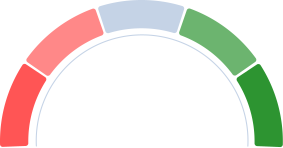

Oscillators
Summary:
Buy
Sell:
1
Neutral:
2
Buy:
6
| Oscillator | Trend | Parameter |
|---|---|---|
|
RSI (9)

RSI (9) – Relative Strength Index with a 9-candle period. Used to identify short-term overbought and oversold conditions, as well as early reversal signals over the last 9 candles.
Close
|
Buy
|
25.73
30
70
|
|
RSI (14)
RSI (14) – Relative Strength Index with a 14-candle period. This is the standard period for RSI, used by most traders to identify medium-term overbought and oversold conditions, as well as potential reversal signals over the last 14 candles.
Close
|
Buy
|
27.46
30
70
|
|
RSI (25)
RSI (25) – Relative Strength Index with a 25-candle period. Used to identify long-term overbought and oversold conditions, as well as potential reversal signals over the last 25 candles. Well-suited for analyzing sustained trends and filtering out false short-term signals.
Close
|
Neutral
|
31.67
30
70
|
|
ADX (14)
ADX (14) – Average Directional Index with a standard period of 14 candles. Measures trend strength, not its direction. Values above 40 indicate a strong trend, between 40 and 20 indicate a weak trend, and below 20 indicate no trend. Calculations are based on the last 14 candles.
Close
|
Rising
|
36.97
20
40
|
|
STOCH (%K)(5,3,3)
STOCH (%K) (5,3,3) – a stochastic oscillator with 5,3,3 settings. It shows the current price’s position relative to the price range over the selected period. It is used to identify overbought and oversold conditions, as well as potential trend reversal points. The values (5,3,3) denote the parameters: 5 – the %K calculation period, 3 – the %K smoothing period (the %D line), and 3 – the %D smoothing period.
Close
|
Neutral
|
31.31
20
80
|
|
MFI (14)
Money Flow Index (14) – a money flow index with a 14-period setting. It combines price and volume to assess the strength of capital inflows and outflows over the last 14 candles. It helps identify divergences and shows how actively money is “flowing into” (above 80 – overbought) or “flowing out of” (below 20 – oversold) the asset.
Close
|
Buy
|
8.75
20
80
|
|
CCI (20)
CCI (20) – Commodity Channel Index with a 20-candle period. It measures the strength of price movement and the deviation of the price from the average value over the last 20 candles. It is used to identify overbought and oversold conditions, as well as potential trend reversal points. The -100 and +100 levels serve as key zones for signaling these conditions.
Close
|
Buy
|
-114.47
-100
100
|
|
Chaikin
money flow (20)
Chaikin Money Flow (20) – Chaikin Money Flow indicator with a 20-candle period. Shows the ratio of buying volume to selling volume. It is used to confirm trend strength and identify accumulation (buying) or distribution (selling) over the last 20 candles (typically days). It ranges from -1 to 1, where positive values indicate an inflow of money and negative values indicate an outflow.
Close
|
Sell
|
-0.46
0
|
|
Williams %R (14)
Williams %R (14) – Williams’ %R indicator with a 14-candle period. Shows the current price’s position relative to the highest and lowest over a period of 14 candles. Used to identify overbought and oversold conditions, as well as potential reversal points and entry/exit points for trades.
Close
|
Buy
|
-89.29
-80
-20
|
|
UO (7,14,28)
Ultimate Oscillator UO (7,14,28) – a composite oscillator with periods of 7, 14, and 28 candles. It combines short-term, medium-term, and long-term momentum for a more accurate assessment of the strength of the trend. It is used to identify divergences and confirm reversals. It is calculated across three time intervals simultaneously.
Close
|
Buy
|
31.15
43
73
|
|
Squeeze
momentum indicator
Squeeze Momentum Indicator – a volatility and momentum squeeze indicator. It identifies moments when the market is in a phase of low volatility, which is often followed by major market movement. It is used to identify the start of momentum trends and breakout points.
Close
|
No Squeeze | - |
Moving Averages
Summary:
Strong Sell
Sell:
11
Neutral:
0
Buy:
1
| 20 | 50 | 100 | 200 | |
|---|---|---|---|---|
|
sma
SMA – Simple Moving Average. Calculates the average price over a selected period. Used to determine trend direction, support and resistance levels, and to filter out market noise. Calculated as the average price over a specified number of candles.
Close
|
Drop | Drop | Drop | Drop |
|
ema
EMA – Exponential Moving Average. Shows the average price of an asset over a specific period, giving greater weight to recent price data, which makes it more sensitive to recent changes and better reflects the current trend than SMA does. It helps smooth out price fluctuations, identify market direction (bullish or bearish), and determine potential support and resistance levels.
Close
|
Drop | Drop | Drop | Drop |
|
hma
HMA – Hull Moving Average. A fast and smooth indicator designed to minimize the lag of traditional moving averages (SMA, EMA). It is used to more accurately and timely determine the trend direction and possible price reversal points. It is calculated based on a combination of weighted moving averages and special smoothing, which allows it to remain sensitive to market changes without an excessive number of false signals.
Close
|
Growth | Drop | Drop | Drop |
Pivot Points
| Points | Parameter |
|---|---|
| r3 | 0.17749999 |
| r2 | 0.17680000 |
| r1 | 0.17629999 |
| p | 0.17559999 |
| s1 | 0.17509999 |
| s2 | 0.17439999 |
| s3 | 0.17389999 |
In addition to the XLM’s technical analysis, pay special attention to the following metrics:
- Stellar Development Foundation (SDF) reserves and expenses. The SDF is a non-profit organization that controls a significant portion of all XLM (approximately 25–30 billion coins). The foundation publishes a quarterly “SDF Mandate Report,” which discloses balances and spending categories (Ecosystem Support, Use Cases, Operations). Large grant and marketing programs result in regular XLM sales on the market and put downward pressure on the price. A reduction in SDF spending and an increase in the share of XLM held in the fund’s secure escrow wallets is a signal for the coin’s growth.
- Adoption in cross-border payments (MoneyGram, Tempo, and other partners). Stellar was originally created as a network for low-cost international transfers. The volume of transfers via MoneyGram Access, integrations with banks and payment providers is a key non-speculative driver of demand for XLM. The more real transactions there are, the better for its price.
- Stablecoins on Stellar (USDC, EURC, BRL, etc.). Stellar is one of the networks officially supported by Circle for native USDC. The growth in the market capitalization of stablecoins on Stellar and the volume of transfers in them directly increases demand for XLM (due to fees, liquidity, and transactions on the built-in DEX). A decline in Stellar’s share of USDC turnover relative to other networks could lead to a potential price drop.
- Tokenization of real-world assets (RWA). Franklin Templeton (FOBXX), a money market fund, is hosted on Stellar, as well as a number of projects from central banks and major issuers. The growth of TVL for tokenized assets on Stellar is a powerful long-term driver of demand. Historically, every major institutional placement has caused the price of XLM to rise by 10–25%.
- Development of Soroban smart contracts. Soroban is Stellar’s smart contract platform, launched in 2024. The dynamics of TVL in DeFi on Soroban, the number of deployed contracts, and active dApps serve as an indicator of whether Stellar is succeeding in moving beyond a purely payment network. Increased activity on Soroban is a potential positive factor for the price of XLM.
- The Anchors network and fiat gateways. Anchors are licensed operators connecting fiat currencies to Stellar. The more active anchors there are across different currencies and jurisdictions, the broader the network’s real-world adoption. The emergence of new anchors in major regions (Africa, Southeast Asia, Latin America) is a fundamental positive factor for price growth.
- Active accounts, transaction volume, and DEX load. Stellar Expert and Stellarchain show the daily number of active accounts, the number of transactions, and trading volumes on the built-in DEX. Increased activity amid a stable or rising price confirms fundamental demand for the coin.
- Behavior of large holders. The top 100 wallets (excluding SDF and exchanges) control a significant portion of the coin’s supply. Transfers from cold wallets to exchanges are a leading indicator of selling, while reverse flows signal accumulation and price growth. Tracked via Stellar Expert or Whale Alert.
- Correlation with XRP and competition for the payments niche. XLM and XRP have historically been perceived by the market as direct competitors in the cross-border remittances segment and often move in sync (with a correlation of 0.7–0.85). Any regulatory news regarding XRP, the launch of an XRP ETF, or the expansion of Ripple Payments simultaneously impacts XLM as well.
- Regulatory environment and institutional adoption. Stellar is actively working with regulators (partnerships with central banks in Ukraine and the EU, CBDC projects). A clear regulatory stance and new institutional integrations are long-term positive factors for the coin. Strict restrictions on stablecoins or payment networks could sharply reduce demand for XLM and its price.
- Correlation with BTC and the broader market. Like most altcoins, XLM is heavily dependent on Bitcoin’s performance. During alt season phases, XLM is capable of outperforming the market (especially on news of payment partnerships). Fed rate decisions and other macroeconomic news influence the price just as much as the network’s own metrics.