


SHIB USDT Technical Analysis
0.00000498$
-3.49%
(24h)
Data as of
15m
1h
4h
1D
1W
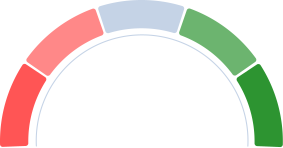

Oscillators
Summary:
Neutral
Sell:
1
Neutral:
8
Buy:
0
| Oscillator | Trend | Parameter |
|---|---|---|
|
RSI (9)

RSI (9) – Relative Strength Index with a 9-candle period. Used to identify short-term overbought and oversold conditions, as well as early reversal signals over the last 9 candles.
Close
|
Neutral
|
50.03
30
70
|
|
RSI (14)
RSI (14) – Relative Strength Index with a 14-candle period. This is the standard period for RSI, used by most traders to identify medium-term overbought and oversold conditions, as well as potential reversal signals over the last 14 candles.
Close
|
Neutral
|
47.05
30
70
|
|
RSI (25)
RSI (25) – Relative Strength Index with a 25-candle period. Used to identify long-term overbought and oversold conditions, as well as potential reversal signals over the last 25 candles. Well-suited for analyzing sustained trends and filtering out false short-term signals.
Close
|
Neutral
|
44.65
30
70
|
|
ADX (14)
ADX (14) – Average Directional Index with a standard period of 14 candles. Measures trend strength, not its direction. Values above 40 indicate a strong trend, between 40 and 20 indicate a weak trend, and below 20 indicate no trend. Calculations are based on the last 14 candles.
Close
|
Rising
|
27.26
20
40
|
|
STOCH (%K)(5,3,3)
STOCH (%K) (5,3,3) – a stochastic oscillator with 5,3,3 settings. It shows the current price’s position relative to the price range over the selected period. It is used to identify overbought and oversold conditions, as well as potential trend reversal points. The values (5,3,3) denote the parameters: 5 – the %K calculation period, 3 – the %K smoothing period (the %D line), and 3 – the %D smoothing period.
Close
|
Neutral
|
68.01
20
80
|
|
MFI (14)
Money Flow Index (14) – a money flow index with a 14-period setting. It combines price and volume to assess the strength of capital inflows and outflows over the last 14 candles. It helps identify divergences and shows how actively money is “flowing into” (above 80 – overbought) or “flowing out of” (below 20 – oversold) the asset.
Close
|
Neutral
|
60.49
20
80
|
|
CCI (20)
CCI (20) – Commodity Channel Index with a 20-candle period. It measures the strength of price movement and the deviation of the price from the average value over the last 20 candles. It is used to identify overbought and oversold conditions, as well as potential trend reversal points. The -100 and +100 levels serve as key zones for signaling these conditions.
Close
|
Neutral
|
-26.1
-100
100
|
|
Chaikin
money flow (20)
Chaikin Money Flow (20) – Chaikin Money Flow indicator with a 20-candle period. Shows the ratio of buying volume to selling volume. It is used to confirm trend strength and identify accumulation (buying) or distribution (selling) over the last 20 candles (typically days). It ranges from -1 to 1, where positive values indicate an inflow of money and negative values indicate an outflow.
Close
|
Sell
|
-0.13
0
|
|
Williams %R (14)
Williams %R (14) – Williams’ %R indicator with a 14-candle period. Shows the current price’s position relative to the highest and lowest over a period of 14 candles. Used to identify overbought and oversold conditions, as well as potential reversal points and entry/exit points for trades.
Close
|
Neutral
|
-43.75
-80
-20
|
|
UO (7,14,28)
Ultimate Oscillator UO (7,14,28) – a composite oscillator with periods of 7, 14, and 28 candles. It combines short-term, medium-term, and long-term momentum for a more accurate assessment of the strength of the trend. It is used to identify divergences and confirm reversals. It is calculated across three time intervals simultaneously.
Close
|
Neutral
|
56.11
43
73
|
|
Squeeze
momentum indicator
Squeeze Momentum Indicator – a volatility and momentum squeeze indicator. It identifies moments when the market is in a phase of low volatility, which is often followed by major market movement. It is used to identify the start of momentum trends and breakout points.
Close
|
Squeeze | - |
Moving Averages
Summary:
Sell
Sell:
9
Neutral:
0
Buy:
3
| 20 | 50 | 100 | 200 | |
|---|---|---|---|---|
|
sma
SMA – Simple Moving Average. Calculates the average price over a selected period. Used to determine trend direction, support and resistance levels, and to filter out market noise. Calculated as the average price over a specified number of candles.
Close
|
Drop | Drop | Drop | Drop |
|
ema
EMA – Exponential Moving Average. Shows the average price of an asset over a specific period, giving greater weight to recent price data, which makes it more sensitive to recent changes and better reflects the current trend than SMA does. It helps smooth out price fluctuations, identify market direction (bullish or bearish), and determine potential support and resistance levels.
Close
|
Drop | Drop | Drop | Drop |
|
hma
HMA – Hull Moving Average. A fast and smooth indicator designed to minimize the lag of traditional moving averages (SMA, EMA). It is used to more accurately and timely determine the trend direction and possible price reversal points. It is calculated based on a combination of weighted moving averages and special smoothing, which allows it to remain sensitive to market changes without an excessive number of false signals.
Close
|
Growth | Growth | Growth | Drop |
Pivot Points
| Points | Parameter |
|---|---|
| r3 | 0.00000503 |
| r2 | 0.00000501 |
| r1 | 0.00000499 |
| p | 0.00000497 |
| s1 | 0.00000495 |
| s2 | 0.00000493 |
| s3 | 0.00000491 |
In addition to SHIB’s technical analysis, pay special attention to the following metrics:
- Burn Rate. To combat internal inflation, SHIB traditionally employs token burning. However, the burn rate is unstable and often drops to several hundred million tokens per day. Sharp increases in burn volumes or the launch of new burn mechanisms are often accompanied by price increases.
- Whales. The top 10 wallets control approximately 60–65% of SHIB coins. Such a high concentration means that a single large sale could very quickly crash the price. This is a significant risk for retail investors. Monitoring the activity of large holders via Whale Alert and Etherscan helps to spot their actions in advance and assess the potential impact on the price.
- The BONE ecosystem. BONE tokens are used to pay for gas fees and validator operations on the Shibarium blockchain, which creates demand for this coin. A rise in the price of BONE indirectly confirms the stability of the ecosystem and draws attention to SHIB (the price rises); a drop in the price of BONE could lead to a drop in the price of SHIB.
- ShibaSwap and TVL. ShibaSwap is the Shiba ecosystem’s decentralized exchange, where users can swap tokens, provide liquidity, and stake SHIB/BONE/LEASH tokens. The TVL metric fluctuates in the range of $25–50 million. If the TVL value is rising, this indicates growing confidence in the ecosystem, and users may start buying the coin, thereby driving up its price. A decline in TVL usually precedes a drop in the token’s price.
- Overall sentiment toward memecoins and seasonality. SHIB is a memecoin, and its price correlates strongly with meme seasons, when retail investors buy speculative tokens en masse. Indicators of such a meme season include: increased trading volumes for DOGE/PEPE/FLOKI, social media activity (Reddit, X), and a rise in the number of new wallets. Another indicator: BTC enters a consolidation phase following its growth. At that point, capital often flows into memecoins.
- BTC and market dependency. SHIB, like all altcoins, is critically dependent on Bitcoin’s dynamics. During an uptrend, SHIB can rise in price very quickly, and during a market correction, it can fall just as easily.