


PEPE USDT Technical Analysis
0.00000295$
0.34%
(24h)
Data as of
15m
1h
4h
1D
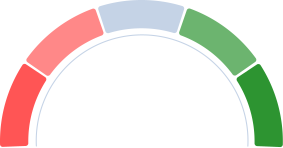

Oscillators
Summary:
Neutral
Sell:
1
Neutral:
8
Buy:
0
| Oscillator | Trend | Parameter |
|---|---|---|
|
RSI (9)

RSI (9) – Relative Strength Index with a 9-candle period. Used to identify short-term overbought and oversold conditions, as well as early reversal signals over the last 9 candles.
Close
|
Neutral
|
44.55
30
70
|
|
RSI (14)
RSI (14) – Relative Strength Index with a 14-candle period. This is the standard period for RSI, used by most traders to identify medium-term overbought and oversold conditions, as well as potential reversal signals over the last 14 candles.
Close
|
Neutral
|
45.62
30
70
|
|
RSI (25)
RSI (25) – Relative Strength Index with a 25-candle period. Used to identify long-term overbought and oversold conditions, as well as potential reversal signals over the last 25 candles. Well-suited for analyzing sustained trends and filtering out false short-term signals.
Close
|
Neutral
|
47.18
30
70
|
|
ADX (14)
ADX (14) – Average Directional Index with a standard period of 14 candles. Measures trend strength, not its direction. Values above 40 indicate a strong trend, between 40 and 20 indicate a weak trend, and below 20 indicate no trend. Calculations are based on the last 14 candles.
Close
|
No trend
|
14.04
20
40
|
|
STOCH (%K)(5,3,3)
STOCH (%K) (5,3,3) – a stochastic oscillator with 5,3,3 settings. It shows the current price’s position relative to the price range over the selected period. It is used to identify overbought and oversold conditions, as well as potential trend reversal points. The values (5,3,3) denote the parameters: 5 – the %K calculation period, 3 – the %K smoothing period (the %D line), and 3 – the %D smoothing period.
Close
|
Neutral
|
47.22
20
80
|
|
MFI (14)
Money Flow Index (14) – a money flow index with a 14-period setting. It combines price and volume to assess the strength of capital inflows and outflows over the last 14 candles. It helps identify divergences and shows how actively money is “flowing into” (above 80 – overbought) or “flowing out of” (below 20 – oversold) the asset.
Close
|
Neutral
|
39.96
20
80
|
|
CCI (20)
CCI (20) – Commodity Channel Index with a 20-candle period. It measures the strength of price movement and the deviation of the price from the average value over the last 20 candles. It is used to identify overbought and oversold conditions, as well as potential trend reversal points. The -100 and +100 levels serve as key zones for signaling these conditions.
Close
|
Neutral
|
-82.96
-100
100
|
|
Chaikin
money flow (20)
Chaikin Money Flow (20) – Chaikin Money Flow indicator with a 20-candle period. Shows the ratio of buying volume to selling volume. It is used to confirm trend strength and identify accumulation (buying) or distribution (selling) over the last 20 candles (typically days). It ranges from -1 to 1, where positive values indicate an inflow of money and negative values indicate an outflow.
Close
|
Sell
|
-0.19
0
|
|
Williams %R (14)
Williams %R (14) – Williams’ %R indicator with a 14-candle period. Shows the current price’s position relative to the highest and lowest over a period of 14 candles. Used to identify overbought and oversold conditions, as well as potential reversal points and entry/exit points for trades.
Close
|
Neutral
|
-72.73
-80
-20
|
|
UO (7,14,28)
Ultimate Oscillator UO (7,14,28) – a composite oscillator with periods of 7, 14, and 28 candles. It combines short-term, medium-term, and long-term momentum for a more accurate assessment of the strength of the trend. It is used to identify divergences and confirm reversals. It is calculated across three time intervals simultaneously.
Close
|
Neutral
|
47.58
43
73
|
|
Squeeze
momentum indicator
Squeeze Momentum Indicator – a volatility and momentum squeeze indicator. It identifies moments when the market is in a phase of low volatility, which is often followed by major market movement. It is used to identify the start of momentum trends and breakout points.
Close
|
Squeeze | - |
Moving Averages
Summary:
Strong Sell
Sell:
10
Neutral:
0
Buy:
2
| 20 | 50 | 100 | 200 | |
|---|---|---|---|---|
|
sma
SMA – Simple Moving Average. Calculates the average price over a selected period. Used to determine trend direction, support and resistance levels, and to filter out market noise. Calculated as the average price over a specified number of candles.
Close
|
Drop | Drop | Drop | Growth |
|
ema
EMA – Exponential Moving Average. Shows the average price of an asset over a specific period, giving greater weight to recent price data, which makes it more sensitive to recent changes and better reflects the current trend than SMA does. It helps smooth out price fluctuations, identify market direction (bullish or bearish), and determine potential support and resistance levels.
Close
|
Drop | Drop | Drop | Growth |
|
hma
HMA – Hull Moving Average. A fast and smooth indicator designed to minimize the lag of traditional moving averages (SMA, EMA). It is used to more accurately and timely determine the trend direction and possible price reversal points. It is calculated based on a combination of weighted moving averages and special smoothing, which allows it to remain sensitive to market changes without an excessive number of false signals.
Close
|
Drop | Drop | Drop | Drop |
Pivot Points
| Points | Parameter |
|---|---|
| r3 | 0.00000296 |
| r2 | 0.00000295 |
| r1 | 0.00000295 |
| p | 0.00000294 |
| s1 | 0.00000294 |
| s2 | 0.00000293 |
| s3 | 0.00000293 |
In addition to PEPE’s technical analysis, pay special attention to the following metrics:
- Whales. The top 100 PEPE wallets have been historically controlling up to 90% of the total token supply. This means that a few large holders could cause the price to plummet by selling their holdings.
- Holder Count Growth. The number of unique wallets holding PEPE is an indicator of interest in the coin. Steady growth in the number of holders (especially small ones) indicates an expansion of the user base and a reduction in dependence on whales. If the number of holders remains flat or declines, this signals waning interest.
- CEX/DEX Volume Ratio. When the majority of trading occurs on CEXs (Binance, OKX, etc.), this indicates widespread interest in the coin. A high share of DEX volume (Uniswap, Cakeswap, etc.) may indicate activity from “smart money” and early adopters. It is characteristic of PEPE that during pumps, up to 80–90% of volume shifts to CEX. Meanwhile, the return of volume to DEXs often precedes a cooling of interest in the coin.
- Liquidity Pool Depth. The TVL in Uniswap pools (PEPE/WETH pair) indicates how large a trade volume can be executed on the Uniswap exchange without significant slippage. A low TVL indicates that even a relatively small sale can cause a noticeable price drop. The depth of PEPE’s liquidity pools fluctuates significantly: it increases during periods of hype and decreases outside of them. This makes the token’s price extremely sensitive to large transactions.
- Social Media Hype Cycles. PEPE is a memecoin, and 70–80% of its price is determined by attention on Twitter/X, Reddit, Telegram, and TikTok. Surges in mentions and memes historically precede price pumps by 1–3 days. A decline in social activity is a reliable leading indicator of a correction. Metrics like Social Volume and Social Dominance (from LunarCrush and Santiment) are the main tracking tools.
- Memecoin Season Correlation. PEPE does not move on its own—it correlates strongly with the overall sentiment in the memecoin sector (DOGE, SHIB, FLOKI, WIF). When money flows into memecoins, PEPE is one of the first to see a price increase. The reverse flow of capital (memes → DeFi/AI) drives the coin’s price down.
- Token Burn Mechanism. PEPE has no built-in automatic coin burn mechanism, and any announcements of new burns are received extremely positively by the market.
- ETH & BTC Correlation. PEPE is an ERC-20 token and is strongly tied to the state of Ethereum. High fees on ETH can reduce activity among small PEPE traders, and a drop in ETH drags down the entire ERC-20 sector. PEPE also reacts strongly to changes in the price of BTC: in a falling market, memecoins suffer much more than other sectors, losing up to 80–95% from their peaks. In a rising market, on the contrary, they grow faster on average than coins from other sectors.