



In this article, you will find answers to the following questions: what is a crypto exchange, what types of exchanges exist and how they differ; how all types of cryptocurrency exchanges work; and how to choose a crypto exchange.
What are cryptocurrency exchanges?
Crypto exchanges are digital platforms that allow you to trade cryptocurrencies (that is, buy and sell them for fiat currency, as well as exchange one cryptocurrency for another).
Types of crypto exchanges
The main difference between exchanges is the level of control over users’ funds and the degree of intermediation in transactions. That is why crypto exchanges are usually divided into three categories:
- Centralized exchanges (CEX) store users’ funds in their own wallets, similar to banks. Users transfer control of their assets to them, and the exchanges provide the trading infrastructure. The most well-known examples are Binance, Coinbase, Bybit, and OKX;
- Decentralized exchanges (DEX) do not hold funds. Users connect their personal crypto wallets to them and trade directly via smart contracts Smart contract Close . Users’ funds always remain under their personal control. The most well-known examples are Uniswap, Jupiter and PancakeSwap;
- P2P platforms (Peer-to-Peer) function as a bulletin board where cryptocurrency buyers and sellers set their own prices, payment methods, and other terms. In this case, the platform does not execute the transaction but merely acts as a guarantor through an escrow account Escrow Close . Most often, they are part of the functionality of CEX exchanges. For example, major P2P services are available on Binance, Bybit, and OKX exchanges.
How a crypto exchange works
Below, we’ll break down how each type of exchange works.
How a centralized exchange (CEX) works
Most beginners start with a CEX. The exchange acts as an intermediary: it holds funds, matches buyers with sellers, and guarantees the execution of the trade. The entire process from registration to the first purchase can be summed up in five steps:
- Registration and verification. The user creates an account on the exchange and goes through the KYC KYC (Know Your Customer) Close verification process — uploading a photo of their passport or ID and taking a selfie. On most platforms, basic verification takes between 10 minutes and several hours, while advanced verification (to increase withdrawal limits) can take up to 48 hours (in my experience, basic verification has never taken more than 15 minutes, but I’ve sometimes had to wait several days for advanced verification). Identity verification is mandatory on most CEX exchanges, although there are a few platforms where verification is optional (BingX, MEXC);
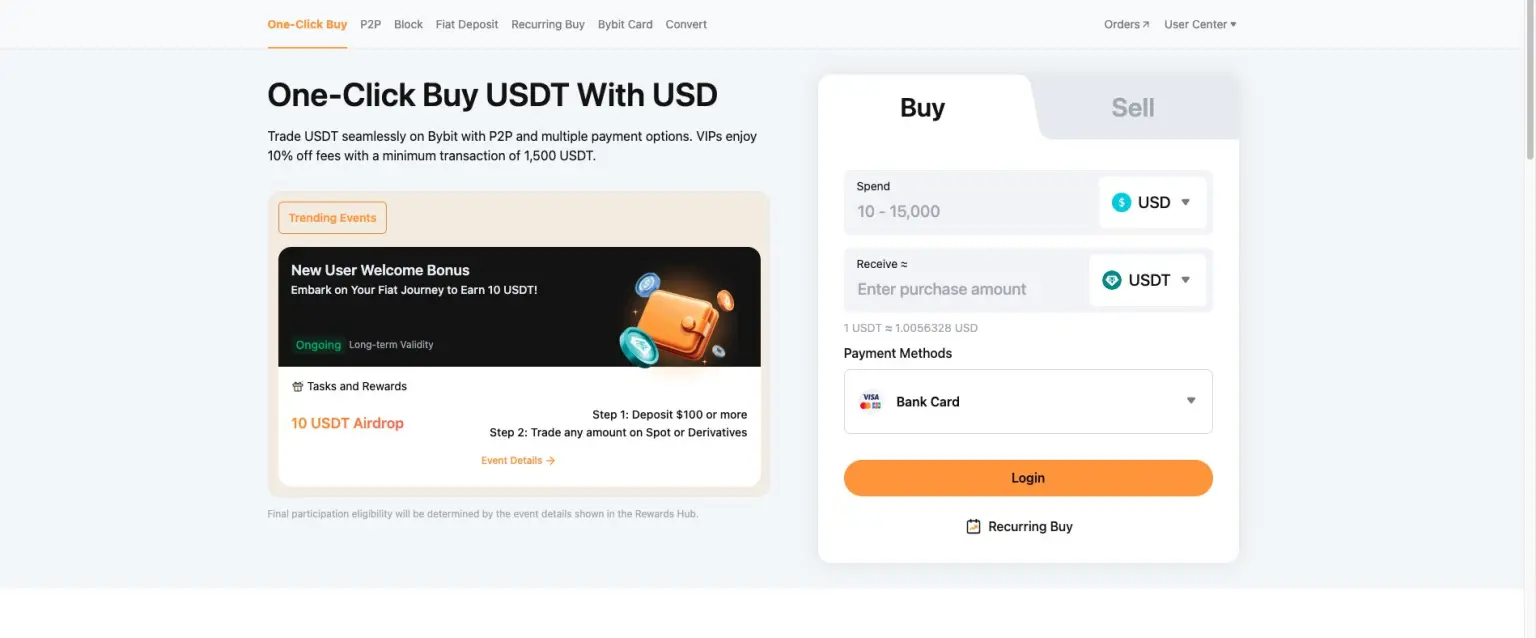
- Depositing funds. To start trading, you need to deposit money into the exchange. There are three ways to do this: bank card, bank transfer, or a cryptocurrency transfer from another wallet;
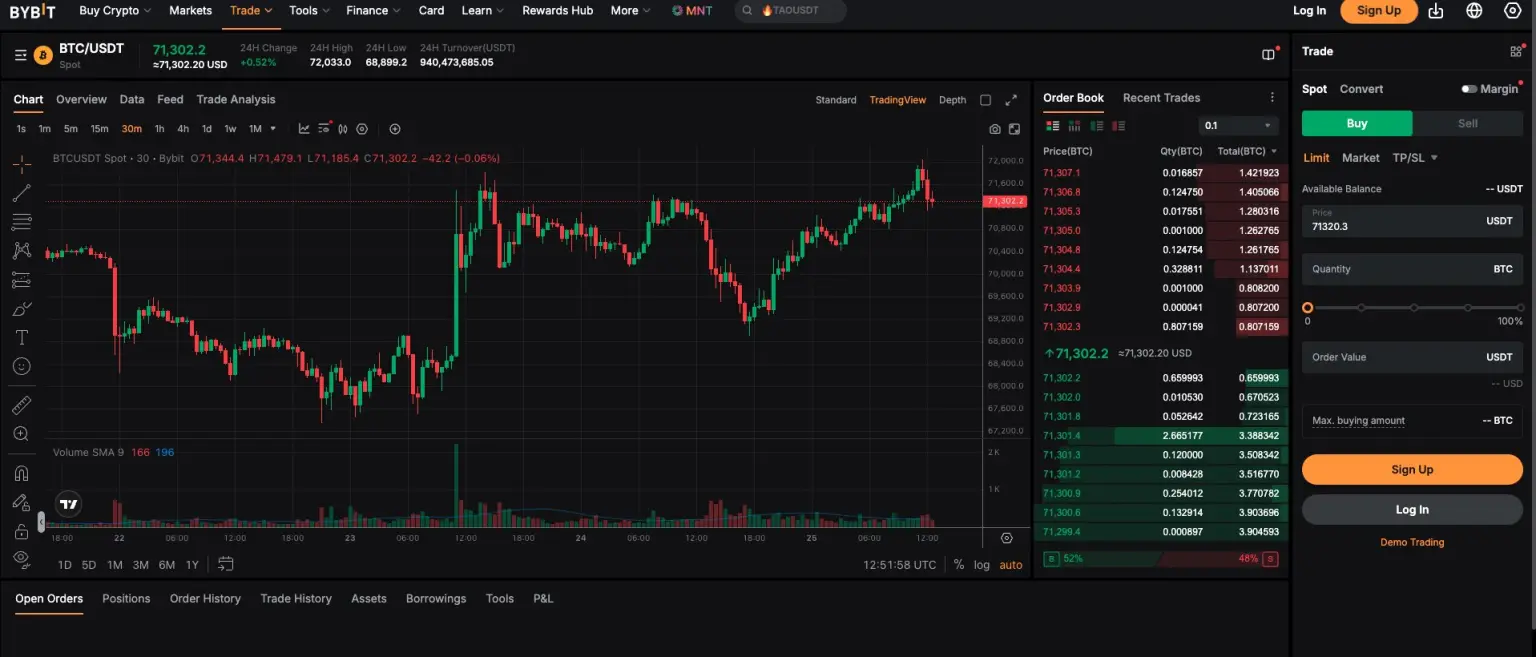
- Placing an order. The trader selects a trading pair, for example, BTC/USDT (buying Bitcoin with the Tether stablecoin), and creates an order to buy or sell. The order enters the order book Order book Close , where all active buy and sell orders are stored;
- Executing a trade. The exchange matches the order with a counter order via a matching engine. On large CEXs like OKX or Bybit, this happens in milliseconds. For each executed trade, the exchange charges a commission — typically between 0.1% and 0.2% of the transaction amount
- Storage or withdrawal. After purchase, the cryptocurrency appears in the exchange account balance. The user can leave it on the exchange for further trading or withdraw it to a personal crypto wallet, gaining full control over the assets. Storing it on the exchange is more convenient for active trading, but withdrawing it to your own wallet is safer, as the security of your funds does not depend on the exchange’s operational status or policies.
How a Decentralized Exchange (DEX) works
On a DEX, there is no registration, no verification, and no deposit. Here, the process looks completely different:
- Connecting a wallet. Instead of creating an account, the user connects their crypto wallet (e.g., MetaMask or Trust Wallet) to the exchange’s website. In this case, the user’s wallet is their “account” — that is where their cryptocurrency is stored;
- Swap. The user selects which cryptocurrency they want to swap (e.g., ETH for USDC), specifies the amount, and confirms the swap. There is no order book here; instead, liquidity pools are used — shared “reserves” of cryptocurrencies that are replenished by other users. The exchange rate is determined by the ratio of coins in the pool: for example, if there is less ETH and more USDC in the ETH/USDC pool, the ETH rate increases. If both coins decrease proportionally, the rate remains unchanged. The swap fee is usually around 0.3%, plus the network fee (or gas fee);
- Cryptocurrency in your wallet. No “withdrawal” is required. After the exchange, the cryptocurrency is immediately transferred to the user’s wallet. This is a key difference from CEX: on a DEX, funds are never transferred to a third party.
How P2P exchanges work
P2P is not an exchange in the traditional sense, but rather a platform that acts as an intermediary between two people. Most often, P2P sections are integrated into large CEXs (OKX P2P, Bybit P2P), but there are also standalone platforms (e.g., Bitpapa). P2P exchanges operate as follows:
- User registration and verification. As a rule, registration requires the same KYC verification as on CEX exchanges. The platform must know both parties to the transaction to minimize fraud;
- Selecting a listing. The buyer sees listings from sellers: each specifies their exchange rate, the available crypto amount, and accepted payment methods (credit card, bank transfer, cash, e-wallets). The exchange rate is set by the seller, so it can be either higher or lower than the market rate;
- Escrow transaction. When the buyer initiates a transaction, the platform locks the seller’s cryptocurrency in an escrow account, and the seller cannot withdraw it until the transaction is completed. The buyer transfers fiat money directly to the seller (to a bank card, bank account, or via another available method). The seller confirms receipt of payment, and the platform releases the cryptocurrency from the escrow account to the buyer. If a dispute arises, the buyer or seller files a complaint, and the platform’s support team investigates the situation;
- Receiving cryptocurrency. After payment is confirmed, the cryptocurrency is transferred to the buyer’s personal wallet. The entire transaction takes 5 to 30 minutes.
How Different Types of Exchanges Work: A Comparative Table
| Criterion | CEX | DEX | P2P |
|---|---|---|---|
| Who controls the funds | Exchange | User | Escrow → user |
| Verification required (KYC) | Yes | No | Yes |
| Transaction speed | Milliseconds | 1–30 seconds | 5–30 minutes |
| Purchase with fiat | Yes (card, bank transfer) | No (crypto only) | Yes (directly to seller) |
| Who is it for | Beginners and advanced users | Advanced users | Beginners and advanced users |
| Examples | Binance, Coinbase, Bybit | Uniswap, Jupiter | Binance P2P, Paxful |
Markets on crypto exchanges
The cryptocurrency industry includes several types of markets tailored to different goals, strategies, and user experience levels. Most major CEX exchanges (Binance, Bybit, OKX) offer access to multiple markets on a single platform.
Spot market
The spot market is the main and simplest market on any crypto exchange. Here, you can immediately buy or sell cryptocurrency at the current market price. Most transactions take place on the spot market: a trader places an order, the exchange executes it, and the cryptocurrency is immediately credited to the account.
Some platforms offer leveraged trading on the spot market. This type of trading is called margin trading — the exchange provides the trader with borrowed funds, increasing the size of their
position
Position
Close
.
Due to the increased risk of losing funds, margin trading is considered a tool for experienced traders, not for beginners.
The derivatives market
Derivatives are contracts whose value is tied to the price of an underlying asset (e.g., Bitcoin), but the trader does not buy or sell the cryptocurrency itself. Instead, they trade a contract on changes in its price. This allows them to profit from both rising and falling markets. The most popular derivative instruments on crypto exchanges are futures and options.
Futures
A futures contract is an agreement under which a trader commits to buying or selling a cryptocurrency at a specific price at a specific time in the future. Typically, a futures contract has an expiration date (for example, in a month or a quarter), after which the contract is automatically settled. However, a unique instrument has emerged in the crypto market that is not found on traditional exchanges: perpetual futures. These are contracts with no expiration date that can be held indefinitely.
Futures allow you to:
- Profit from both rising and falling prices – open a long position (bet on a price increase) or a short position (bet on a price decrease). In the spot market, you cannot profit from a price drop, but futures offer this opportunity;
- Use leverage – on some exchanges, leverage can reach up to 125x, which multiplies both potential profits and losses;
- Hedge risks – protect your crypto portfolio Crypto portfolio Close from short-term price drops. For example, if your spot portfolio starts to lose value, you open a short position on futures for the same assets. The market falls—the spot price drops, but the short position generates a profit, offsetting the losses.
Options
An option is a contract that gives a trader the right, but not the obligation, to buy (call) or sell (put) a cryptocurrency at a specific price by a specific date. For this right, the trader pays a premium — a fixed amount upon opening the contract.
The key difference from futures is that if the market moves in the wrong direction, the trader simply does not exercise the option and loses only the premium paid, rather than the entire position. This makes options a more flexible hedging tool, but also more complex to understand.
Cryptocurrency options are offered by platforms such as Deribit (the largest by options trading volume), as well as Binance and Bybit. This instrument is designed for professional traders with a deep understanding of market strategies.
Markets on crypto exchanges: a comparison
| Criterion | Spot | Futures | Options |
|---|---|---|---|
| Essence | Buying/selling cryptocurrency at the current price | Contract for the future price of an asset | Right (not obligation) to buy/sell at a fixed price |
| Ownership of the asset | Yes, cryptocurrency is credited to the balance | No, only the contract | No, only the contract |
| Profiting from a price drop | No | Yes (short position) | Yes (put option) |
| Maximum loss | Purchase amount | Entire position (liquidation) | Only the premium paid |
| For whom | Beginners and advanced traders | Experienced traders | Experienced traders |
| Examples of platforms | Binance, Coinbase, Bybit | Binance, Bybit, OKX | Deribit, Binance, Bybit |
How to choose an exchange
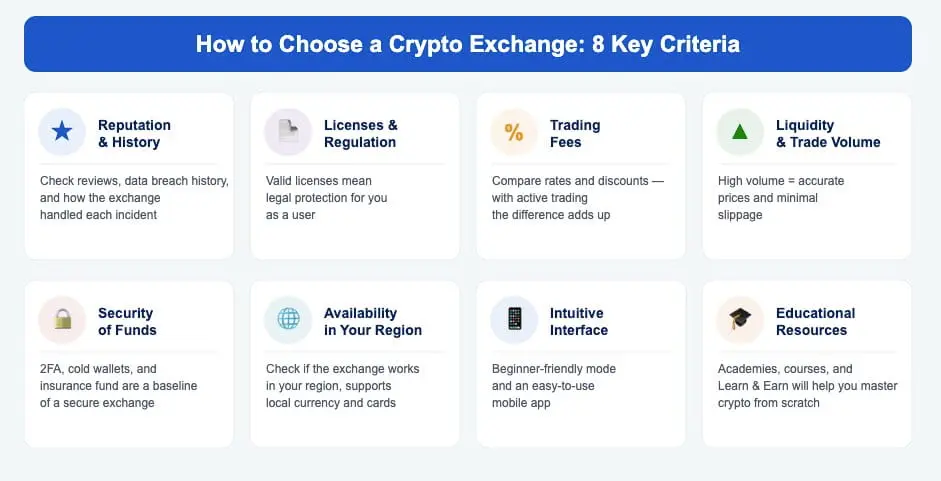
There are dozens of crypto exchanges on the market, and they all differ significantly from one another. Let’s take a look at the main criteria to consider when choosing a platform.
Reputation and age
The longer an exchange has been operating without major scandals, the better. For example, Binance was launched in 2017, Coinbase in 2012, and Kraken was founded in 2011.
It’s also worth checking whether the platform has been hacked in the past and how it handled those incidents. For example, in 2019, the Binance exchange lost $40.7 million due to a data breach, but fully compensated users for their losses from the SAFU insurance fund.
Licenses and regulation
Reliable exchanges obtain licenses in heavily regulated jurisdictions. Coinbase, for example, is licensed in the US and has obtained a license MiCA license in the EU, while Kraken is registered in the UK (FCA). Having a license means that the exchange undergoes audits, complies with KYC/AML requirements, and is responsible for the safety of user funds.
Fees
Fees vary across different platforms and typically range from 0.01% to 0.5% per trade. However, on average, major platforms charge around 0.1% of the transaction amount (this is the rate, for example, at Binance and Bybit).
At first glance, 0.1% doesn’t seem like much. But with active trading, commissions add up much more noticeably: for example, 10 trades a day at $1,000 each amounts to $10 a day, or about $300 a month. That’s why many exchanges offer loyalty programs that reduce commissions as trading volume increases or when internal tokens are used. For example, on Binance, paying fees in BNB gives a 25% discount , and on Bybit, there is a VIP program with reduced rates for active traders.
Liquidity and Trading Volume
The higher the trading volume, the easier it is to buy or sell cryptocurrency at market price without significant slippage Slippagе Close . For example, the daily trading volume of the largest exchange, Binance, is $6,087,162,362.93, so trading there is quite convenient.
Security
The basic requirements for any reliable exchange are two-factor authentication (2FA), storing the majority of funds in
cold wallets
Cold wallet
Close
(i.e., wallets without internet access), and an insurance fund in case of a hack.
For example, Binance has the SAFU fund (~$1 billion), and Coinbase has $255 million in hot wallet insurance through Lloyd’s of London syndicates. The effectiveness of such funds was demonstrated by the Bybit hack in February 2025 — when $1.5 billion was stolen from the exchange, but it fully restored its reserves within 72 hours without freezing withdrawals.
Availability in your region
Before registering, it’s important to check three things: whether the platform is available in your region, whether it supports your local currency and bank cards, and whether there are any restrictions on specific features. For example, the global version of Binance is not available in the U.S. — American users can only use the separate Binance.US platform with limited functionality. Coinbase, on the other hand, is focused on the U.S. market and for a long time did not support direct transfers in hryvnias or rubles. In a number of countries (China, Algeria, Nepal), crypto exchanges are banned by law. Even if an exchange is technically accessible, you should make sure it supports a deposit method that works for you — such as a bank card, local bank transfer, or e-wallet.
Intuitive interface
For a beginner, it is important that the exchange offers a simple buy/sell mode, not just a professional trading terminal with charts. Most major platforms (Binance, Bybit, Coinbase) offer both options. The availability of a user-friendly mobile app is also crucial, as many users trade from their phones.
Availability of educational materials
A crypto exchange is a tool that requires learning, which is why many major exchanges offer free educational resources to help beginners understand the basics of using the exchange. For example, Binance Academy contains over 400 articles, video courses, and interactive lessons — ranging from basic concepts to advanced trading strategies. Some exchanges also launch Learn & Earn programs, in which users receive small amounts of cryptocurrency for completing training modules. For a beginner, having a clear educational resource on the exchange can be just as important as a user-friendly interface.
Conclusion
Crypto exchanges allow you to buy, sell, exchange, and store digital assets.
When choosing a platform, it’s important to consider security, fees, available trading pairs, user-friendliness, and the exchange’s reputation. Beginners should pay special attention to the availability of educational materials, demo accounts, and quality customer support.
Once you understand what a crypto exchange is and how it works, you’ll be able to start your journey into cryptocurrencies with greater confidence.


